
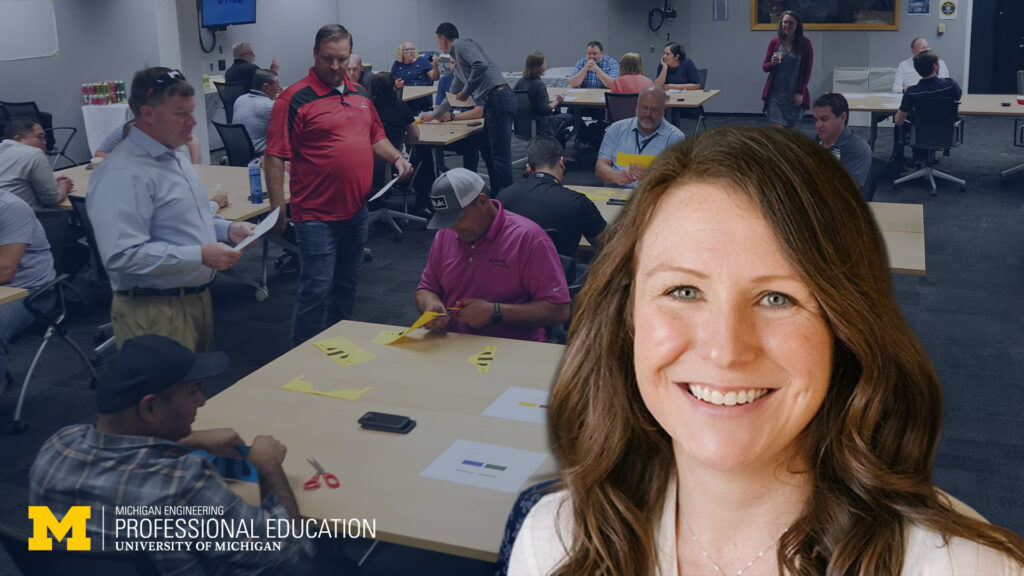
Nicole Friedberg has built a career centered on engineering, continuous improvement, and helping others succeed. As a Michigan Engineering graduate, she has applied her expertise across roles at Lockheed Martin, Fiat Chrysler, and GM Financial. Today, Nicole serves as a course instructor for Michigan Engineering Professional Education, teaching courses in Lean Six Sigma, project management, and AI.
Friedberg shares her journey from engineering student to industry professional and educator, talks about the mentors and experiences that shaped her career, and reveals her perspective as a woman in engineering.
1. What first sparked your interest in engineering and STEM?
Friedberg: In my senior year of high school, I took an AP Physics class that I really enjoyed. I remember talking to my teacher, Ms. Deyo, about my college plans. When I told her I was considering Michigan State, she said, “I really think you should apply to the College of Engineering at Michigan.”
When I started at Michigan, I was convinced I would study mechanical engineering. At the time, I took a class where a different professor would come in each week and introduce us to a different engineering discipline. When the industrial and operations engineering professor spoke to our class, something just clicked. I remember thinking, “This is already how my brain works. This just makes sense. This is what I’m meant to do.”
That experience ultimately led me to declare a major in Industrial and Operations Engineering.
2. What were some of the early experiences that shaped your career?
Friedberg: When I graduated in 2008, the economy was struggling, especially in Michigan. I had several job offers and ultimately chose an opportunity with Lockheed Martin in California.
I joined the Space Systems division through a leadership development program, where I rotated through several roles and gained experience across different areas of the company. One of those rotations involved helping redesign an internal training program to make it more participant-centered and engaging. I also trained other trainers, coached colleagues, and supported special projects across the country.
I eventually moved back to Michigan and joined what was then Fiat Chrysler, now Stellantis, at an engine manufacturing facility in Detroit. That experience taught me a lot about the importance of working directly with people on the manufacturing line and involving them in the improvement process.
When I transitioned to GM Financial International Operations, I learned how to work with teams spread across the globe and different leadership styles.
3. When did you first become interested in Lean Six Sigma, and how has it influenced your career?
Friedberg: My interest in Lean Six Sigma began during my junior year at the University of Michigan, when I took IOE 461 with Dr. Pat Hammett. That was my first introduction to Six Sigma, and I remember thinking, “Oh, this is great. This approach can really work.”
After college, I continued building on that foundation at Lockheed Martin. My manager encouraged me to earn my Green Belt, and I later completed the Black Belt program while working with the department responsible for Six Sigma training. That gave me the opportunity to move beyond learning the methodology, designing training to teach others the methodology, and begin applying it to several critical programs and high-visibility projects. I ended up winning an award for Best Structured Improvement Activity at the company for my work supporting a critical program through Lean Six Sigma projects.
As my career progressed, I wanted to take that experience even further. While at GM Financial, I returned to the University of Michigan to complete the Master Black Belt program with Dr. Hammett. This gave me the foundational knowledge to design a Lean Six Sigma program at the organization from the ground up, including identifying and prioritizing projects, identifying and training candidates, executing, mentoring, and tracking project performance, and quantifying financial benefits.
4. What do you enjoy most about being an engineer?
Friedberg: I love being able to give people the tools they need to be successful and make meaningful changes. For me, it’s about helping people grow in their careers while equipping them with the skills to improve processes and systems within their organizations that can also positively impact people in their day-to-day work.
I am thrilled to continue supporting people’s growth and development by providing additional tools focused on real-world application as a lecturer in the Mechanical Engineering department at the University of Michigan.
5. What project or accomplishment in your career are you most proud of, and why?
Friedberg: It’s difficult to pick just one because I’ve had the opportunity to work on several projects that I’m proud of. One that stands out is my work at Lockheed Martin as a systems safety engineer. I worked on satellites while also supporting quality engineering, and there was something incredibly rewarding about contributing to something that would actually go into space.
At Fiat Chrysler, I was part of the launch of the Pentastar engine at Mack Engine Plant. Our team helped transition a manufacturing line to produce the new engine while scaling production from one shift to three. Being part of a major product launch and seeing that work translate directly to the manufacturing floor was another memorable experience.
I also supported a newly acquired shop in Florida while I was at Lockheed Martin. The team needed to significantly scale production to meet a large government order, and I was part of a team that worked closely with them, around the clock, to identify efficiencies and increase their capacity using the resources they had available.
These projects were very different, but they gave me the opportunity to solve complex problems, improve processes, and see the tangible impact of my work.
6. Have there been mentors or colleagues who have played an important role in your career?
Friedberg: My mom was a significant influence. In 1976, she became the first woman hired at Union 76 as a sales representative. She worked in sales, selling parts and supplies to independently owned franchises, but everyone in sales was also required to complete mechanics training. They had to special-order a woman’s jumpsuit for her. Seeing her enter a space where women had not traditionally been represented showed me that I could pursue the path I wanted without letting other people or expectations stand in my way.
Dr. Pat Hammett also became an important mentor. Later in my career, we reconnected when I returned to Michigan to complete the Master Black Belt program. He eventually asked me to help overhaul some of his classes, which led to my continued work at Michigan and, eventually, a faculty role.
I have had other notable leaders throughout my career that I often reflect on and pull components of their styles into my own.
7. How have opportunities for women in engineering changed throughout your career, and what has your experience been like?
Friedberg: When I think about the number of women currently enrolled in the College of Engineering compared with when I was a student in the early 2000s, the difference is significant. There are many more women studying engineering today, which is encouraging to see.
Earlier in my career, I often worked in predominantly male environments, and I learned to be thoughtful about how I communicated, built relationships, and gained support for new ideas.
Sometimes those differences showed up in unexpected ways. While working on satellites at Lockheed Martin, I once had to put a clean room suit on over a pencil skirt. It was definitely a challenge, but it’s a funny reminder of some of the experiences I encountered early in my engineering career.
8. What advice do you have for women entering careers in STEM?
Friedberg: Don’t get discouraged. Stay confident in what you bring to the table, be willing to learn, and build relationships with mentors and colleagues who can support your growth. You don’t have to have your entire career figured out from the beginning. Be open to new opportunities and allow your path to evolve as you discover new interests.
And one practical piece of advice from experience: Don’t wear a pencil skirt in a clean room.
Learn more about Lean Six Sigma programs
