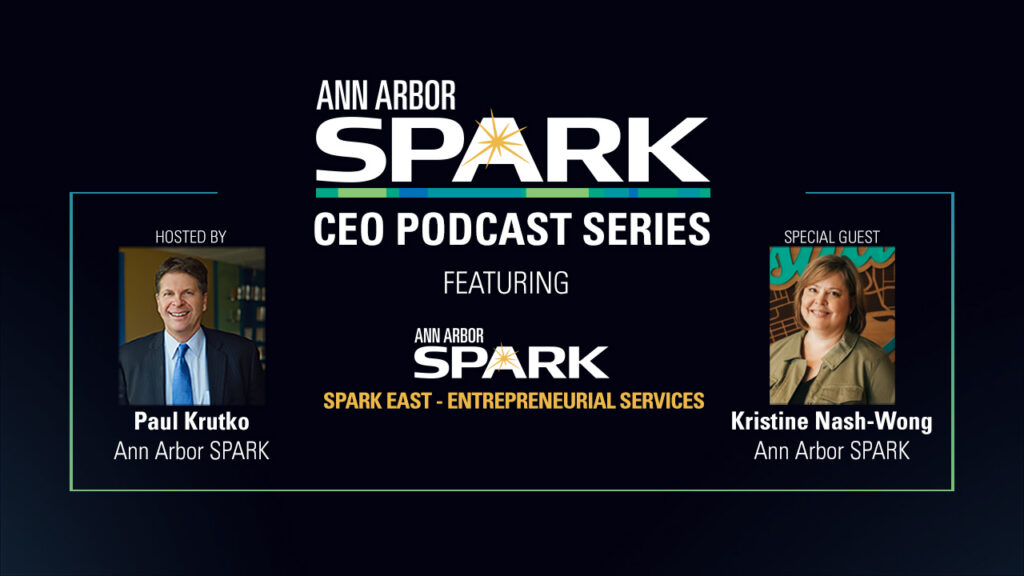
In this episode, Paul Krutko talks with Kristine Nash-Wong about what’s happening on the ground for entrepreneurs and small businesses in Ypsilanti. They dig into the role of SPARK East, what makes the Ypsilanti business community so distinctive, and how SPARK is expanding its support beyond tech startups to better serve local businesses. Along the way, they share a behind-the-scenes look at programs designed to make resources more accessible — and what it really takes to turn an idea into a sustainable business.
READ INTERVIEW
Paul Krutko: Welcome to Ann Arbor SPARK’s CEO Podcast…Conversations on Economic Opportunity. My name is Paul Krutko, and I’m the President and CEO of Ann Arbor SPARK.
Today’s guest is Kristine Nash-Wong, Director of Entrepreneurial Services at Ann Arbor SPARK and the leader of the SPARK East Innovation Center in Ypsilanti. Kristine works closely with early-stage founders, helping them navigate the path from idea to growth by connecting them with the resources, mentorship, and strategic guidance they need to succeed.
She brings more than 25 years of experience in marketing, strategic planning, and business development, and has spent much of her career helping technology companies gain market share and scale their impact.
Today we’ll talk about what she’s seeing on the front lines of entrepreneurship in the Ann Arbor and Ypsilanti region, how SPARK supports founders at every stage, and what it really takes to turn a promising idea into a sustainable company.
So Kristine, thanks for doing this today.
Kristine Nash-Wong: My pleasure. Thanks.
Paul: So Kristine, a lot of people may not be familiar with what we do at SPARK East, what kinds of support and resources are available there for small businesses and their owners and founders. So talk a little bit about SPARK East and what we’re trying to offer there to the small business community.
Kristine: Yeah, sure. So first, I get that question a lot. So are you related to Ann Arbor SPARK or how do you work with Ann Arbor SPARK? And the short answer is we’re just a different physical location of the exact same organization. We provide all of the same services and resources. We work closely with our Ann Arbor colleagues, but we’re physically located in Ypsilanti. We’re on Michigan Avenue in downtown. We have a storefront and people can walk in. And in terms of services, we support entrepreneurs, meaning startups and small businesses through the idea, the startup, the growth stages of their business. And we do that with education, coaching, and connections to other local resources.
Paul: Yeah. I’m glad you highlighted that at the beginning because it was very intentional by my predecessor, Mike Finney, as CEO and the board at that time, that they wanted to have a physical presence in downtown Ypsilanti. So it’s interesting that you get the question, are we connected or not connected? So we once had a physical presence in Livingston County, at one point in time. But this location, SPARK East, is really something that the board wanted to establish very early on in SPARK’s history.
So I think from my perspective, and probably from yours, Ypsilanti has a really unique entrepreneurial culture, maybe different from Ann Arbor proper. From your perspective at SPARK East, what makes the Ypsi small business community special?
Kristine: Yeah. So between the initial consulting work I did with SPARK and my current role, I’ve actually been working in Ypsi for almost seven years. And so from my perspective, I think the business owners, the startups, the small businesses, they have everything it takes really to make it in the long term. They’re tenacious, they’re inquisitive. They know when to ask for help, which is probably one of the most important things for a founder.
But we also recently did a series for a marketing campaign where we asked local Ypsi business owners what they thought was the unique or cool thing about Ypsi. And their answers were pretty consistent across the board. So they mentioned diversity, creativity. We have a lot of art and food businesses in Ypsi, that Ypsi businesses are community-driven and they’re very authentic, so they’re true to who they are. And I think those are all true answers.
Paul: Very interesting perspective. So over the past few years, one of the things that we wanted to talk about today is that we have expanded the way we support small businesses. In fact, I saw something on, I don’t know why I was looking at Nextdoor today, but I did. And someone was commenting that SPARK has a tech-focused sort of remit. And one of the things we’ve tried to do with your help in Ypsilanti is support small businesses that are not tech startups. Can you talk about why that’s important? And I think that’s obvious, but why that’s important and how those programs really help strengthen the local economy, why we went in this direction, and have you lead it?
Kristine: Yeah. Well, not sure why you had me lead it. I can’t speak to that, but I have been working in this field for a few minutes. I think what you said, it is a bit obvious, but I’ll state the obvious. Also, I think there’s probably sort of an eggs in one basket analogy in there somewhere, but the idea is pretty simple that it requires a mix of companies to have a healthy economy. You need the large corporations and businesses. You need some high-growth startups in there, and you also need small businesses all working together. They all have sort of a unique role and value, but I do think that small businesses have a unique contribution at the community level. The money that they invest goes back into the community; they hire locally. When you have more small businesses, you have a more stable economy, you can absorb shocks like the pandemic or market changes a little bit better when you have a really strong small business community. So I think we talked about the fact that they do a lot locally, they hire locally, their supply chain is local often.
And in Ypsi, I do think that it’s probably a little bit simpler than that. And they’re all our neighbors. We are on a main street and we see them every day.
Paul: Right. Well, we’ll talk about the small business hub a little later in our conversation. But one thing I wanted to point out in context of this is that SPARK is not making a choice to support one business type versus another. It’s driven by the funding resources that we have. So the focus that SPARK has had since its very beginning is that it is well-resourced and in fact, defined resources that can only be spent to help early-stage tech companies grow. And so as someone from looking at someone listening to this or somebody outside looking at our website and sees things that we do, it’s largely driven by who is willing to provide resources to us to do those things. I mean, we don’t sell widgets, we don’t have any revenue generation. We have to get local government or the academic community or private sector to give us resources.
And so what has happened recently is that, or long term, the county particularly wanted, Washtenaw County wanted to see us do things in the eastern side of the county. So they gave us resources to do that. And then we have gotten some resources recently from the federal government through the state that said, “Well, you guys do a really good job working with early-stage tech companies. Can you apply the same concepts to local businesses?” And so we raised our hand and said, “Yeah, we would do that.” So I just wanted to point out that part of what drives us is not so much … If we had our druthers, we would get resources and we would be able to serve all kinds of businesses, but a lot of it depends on who’s willing to fund us. So let’s keep moving on.
We got some more questions. SPARK East offers coworking space and incubator suites. How does that work that you have that accessible space for entrepreneurs and small business owners together? And I mean, I also think you might want to touch on the fact that our facility is sort of a community resource too, beyond the companies that you’re helping.
Kristine: Yeah, I think we are very honored to open our doors to the community. We host a number of community nonprofits in our space, and those include community partners like SOS, but that also includes city organizations if they need to have events or the historical society. It’s just a wide variety of folks from all walks of life.
In terms of the businesses that we work with, we do host both small businesses and startups in our coworking space. I think the benefits for a coworking space are probably pretty plain in terms of accelerating business growth. You can get low cost access to services like wifi, printing, conference rooms at SPARK East. That also includes a lot of caffeine and snacks, which is important to helping with innovation. But I do think that we’ve all seen a shift in how people are going into the office lately.
And so for us, the small businesses and the startups that come in are really looking for, I think, what they can get beyond the screen at home. They’re looking for the networking, they’re looking for the in-person innovation, the brainstorming sessions, and they’re really using the facility as an opportunity to network with other businesses like them, other businesses that aren’t like them, and to cross-pollinate ideas.
Paul: Yeah. And I think it’s also really important to point out that while in Ann Arbor we have had a lot of private sector entries into the coworking availability space, that in Ypsilanti proper, we are really providing something that there isn’t a lot of private sector sort of alternatives for that. I think with MI-HQ, there’s some opportunities there, but for a long time, we’ve been sort of the place where the community can gather in the way that you described, and we’re pleased to do that.
So you recently launched the Entrepreneur Resource Studio at SPARK East. What is that and how does it help small businesses gain access and expertise and resources that they might not otherwise have the opportunity to get?
Kristine: Yeah, I think that question is sort of closely related to the last one in terms of accessibility. So one of the things we talk about a lot is making sure that there’s no wrong door for an entrepreneur. And so we want to make sure that there’s sort of a warm connection to the right resources, even when it’s not SPARK that’s providing those resources. So with the storefront, the fact that we are literally on the sidewalk, we have a lot of folks who walk in and they say, “I want to start a business,” or, “I’m looking to expand,” or, “I need help with my taxes,” or, “Can you help me with this specific question I have on QuickBooks?” That was a question I had last week. And so we started the Entrepreneur Resource Studio as well as the Small Business Navigator Program to help answer those questions in a timely way with expert resources and to ensure that they were of no cost to the businesses that are in the community.
So every Thursday we host subject matter experts, and that’s lawyers, accountants, marketing, sales experts. We have some product packaging people, some food experts. They all come in and they offer 30-minute sessions for small businesses in the local community to meet and answer those questions.
We also have the small business navigators on site, and they really act as experts in small business and the community resources that we have for small businesses. So if they don’t know the answer, they will connect them to those resources and they’re able to answer those questions in a really timely manner because when a small business comes in and they say, “Hey, I can’t get my invoices out. My QuickBooks isn’t working,” we need to be able to connect them to someone so that they’re keeping their cash flow and their staff and everybody happy. So that has been really the impetus behind those two programs.
They’ve been, I think, well utilized by the community. And I think in terms of answering questions, there’s another aspect to that, which is the SizeUp SPARK business intelligence software. So I know there’s an entire other podcast on that, but it’s worth mentioning in terms of answering some of those questions. It’s really helpful. It’s a free software solution that we offer on our website, and any small business can go in and look through that. And we also have our small business navigators that will provide training on that solution. So they can walk people through like, okay, if I do expand my business, what’s the best location? What can I expect to pay my staff? And what kind of revenue would I expect to make in a year?
Paul: Yeah. I’m glad you mentioned that, and we would encourage people who might be listening to this, that they ought to go on our website and look for the podcast about SizeUp or go on the website and find the link for SizeUp. We’re really pleased that [we can offer it], and it’s an example of a thing that we found that a company was doing in other communities around the country, and we were able to get Bank of Ann Arbor to sponsor it. And it is a tool that, as you described it, many people will say, “Oh, I want to start a business, and this is the business that I think I have expertise in. ” But what they need to learn, I guess, is, well, if you’re going to hire people, what’s the market rate for people in that business? You can find that out. And it’s to our geography. It’s not like national, and you can identify and see where there are competitors, where there isn’t, that your business is offering a service in a particular part of our community. So it’s a really valuable tool that we really appreciate the opportunity to give to the community. So I’m glad you mentioned that.
So last question, and maybe this will be more of a lengthy kind of conversation point. We are operating the Small Business Support Hub and operating it from your location in Ypsilanti, but with partners that you’ll describe. So for listeners who aren’t familiar with it, what is it and how does it help small businesses find the support that they need?
Kristine: Yeah. So it’s funny, I was looking back just recently at our records and we launched the Small Business Support Hub almost two years ago to this day. And the goal behind that was to support small businesses with more intensive one-on-one business coaching so they can really dig in on some specific issues that they want help with. Or if it’s a business that wants to get started, that idea stage, like how do I go from idea to business plan, to registering in LARA, to getting my EIN and bank account, all those fun things, and also have the ability to execute and get revenue afterwards.
So far, working with our community partners, we have partners across three counties. So we range from Livingston to Washtenaw to Monroe [counties], and we’ve been able to work with more than 500 businesses in those two years to provide those services. And we’ve also helped over a hundred new businesses get started, which I think is kind of cool.
And in terms of the actual mechanics of the programs and how they work, all of that is on our website. It is underneath the services tab at our website, and you just go to small business support, and it details everything we have about the Small Business Hub, how you can get connected with the business coach, et cetera.
Paul: Yeah, it’s interesting to share with the audience where this concept came from. We, as I mentioned earlier, we are well-resourced to provide the kind of business support to an early-stage tech company. And through the resources that the Biden administration made available out of the COVID situation, the state asked those of us who provide those kinds of direct service delivery to tech companies if we could provide the same kind of support to locally-facing types of businesses. And so there were resources made available. One of the things that I’m going to pitch in this conversation is we are looking to continue that program. That was a federally funded program that will last for probably another year or so. And we are actively trying to, because again, given what you just said, we’ve been able to help 500 businesses specifically, a hundred to start up. In today’s economic environment, a lot of people who are maybe faced with challenges where they’re working now are thinking about, well, what’s my alternative?
And there are a lot of folks that then think about, well, can I start a business? Can I do that myself? So we really like the program. I’m actively trying to identify funders for us to continue it, but if anybody who’s listening to this has some resources that they want to make available, we would be glad to receive them to continue the program.
So Kristine, I really want to thank you for taking some time today. This is part of my continuing effort to make sure that the community has the ability to understand all the things that SPARK does. You’re playing a really important role. I have to give Kristine some props here. I mean, we asked her to do many things, and one of them is to lead the SPARK East location despite all the other work she’s doing specifically, and she does a great job with that and represents us very well. So I want to thank her for all her work there in SPARK East.
And I want to thank our audience for listening and learning more about SPARK and how we impact the Ann Arbor region’s economic future. These conversations are brought to you by Ann Arbor SPARK. For more information about Ann Arbor SPARK, you can find us on the web at annarborusa.org. We’re also on Facebook, Instagram, and LinkedIn.
Kristine Nash-Wong’s Bio
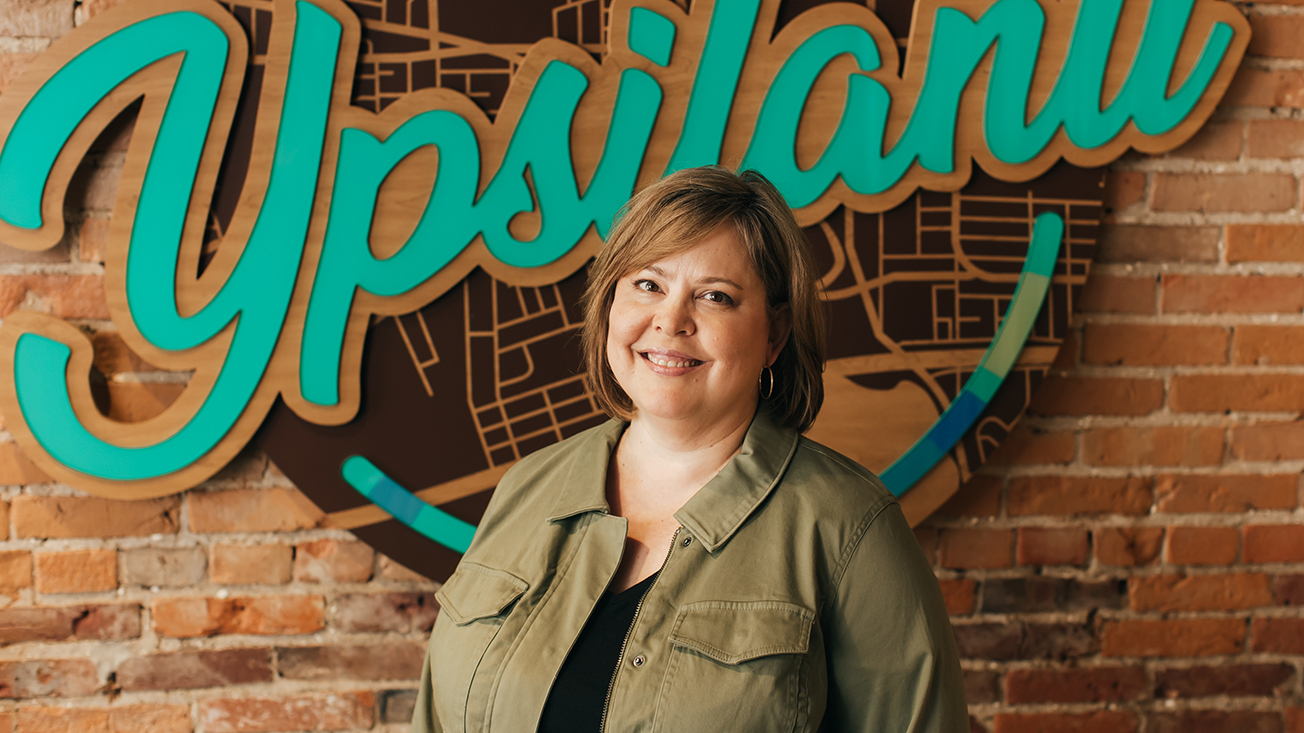
As the director of entrepreneurial services at the SPARK East Innovation Center in Ypsilanti, Kristine helps early stage startups accelerate their growth by providing strategic consulting and marketing services. A strategic planner with more than 25 years of marketing experience, Kristine specializes in helping technology companies gain and grow market share. She is passionate about helping mission-driven companies deliver scalable, sustainable solutions.
Before joining SPARK, Kristine founded the consulting firm Health Sapience which provided specialized consultancy helping health service and technology providers successfully scale. In this role, Kristine honed her expertise in strategic planning, marketing communication, business development, and design services.
Kristine’s previous experience in the Ann Arbor/ Ypsilanti SmartZone includes serving as marketing director for HealthMedia, an Ann Arbor-based healthcare startup that was acquired by Johnson & Johnson. She has also previously served as a judge for the Acceleration Michigan Innovation Competition and the Blue Ocean Strategy High School business competition.
Kristine earned a Bachelor of Science in Health Promotion Management at York College, City University of New York.
