
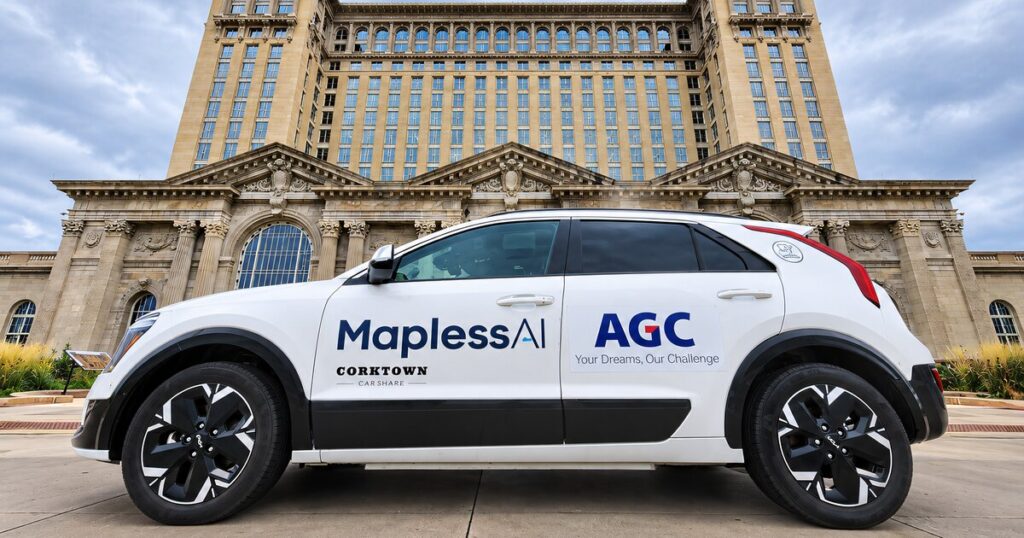
AGC Automotive Americas, in collaboration with FORT Robotics (formerly Mapless AI), today announced the launch of its hidden on-glass 4G/5G Retrofit Antenna for a live remote driving program operating on public roads in Detroit’s Transportation Innovation Zone (TIZ). The deployment marks a transition from CES 2026 demonstration activity to active real-world operation supporting remote vehicle driving capabilities.
The Detroit program is believed to be one of the only current implementations of a remotely operated vehicle system approved on US roads today utilizing hidden and transparent glass-integrated antenna designed to eliminate the need for bulky rooftop connectivity modules often used in on-road teleoperation systems.
From Live Demo to Road Deployment
January’s CES demo showcased an aftermarket remote-driving system kit live in operation, highlighting how antenna-integrated automotive glass can support the high-bandwidth, low-latency vehicle communications required for teleoperations—without additional visible rooftop hardware. The demonstration received industry attention and established the foundation for real-world operation in Detroit.
AGC is the world’s largest automotive glass manufacturer by market share, and its global connectivity R&D teams have been developing, testing and validating integrated glass antenna designs for market-leading OEMs since the 1970’s. As smart mobility trends evolve in today’s automotive industry, the company is developing solutions for tomorrow’s customers and use cases, working with partner FORT Robotics for this on-road proof-of-concept aimed at future applications in OEM mass-production vehicles.
Following Mapless AI’s acquisition by FORT Robotics in May of this year, that concept has now moved into live operation on public roads, with AGC’s antenna architecture actively supporting remote operation in real driving conditions.
The remote driving platform originally developed by Mapless AI is now part of FORT Robotics’ comprehensive Trust Layer for Physical AI, which includes solutions for active onboard safety, human-in-the-loop control, and outside-in safety. AGC’s hidden connectivity solution utilizes a distributed antenna design with multiple hidden and transparent 5G antennas tucked away in the corners of the windshield and back window. This distributed design contributes to a more stable connection, helping to ensure safety and uptime.
Taken together, AGC Automotive Americas and FORT Robotics now have a uniquely differentiated remote operations kit that does not require any additional external body antenna and can be easily retrofitted for compatible aftermarket fleets or natively integrated for future OEM vehicles.
Sleek Design Integration with End Users in Mind
Traditional teleoperation vehicle configurations often require rooftop-mounted antennas and modem systems that alter vehicle appearance while increasing installation complexity and cost—often needing to drill holes in the vehicle body for aftermarket retrofits.
An integrated glass antenna approach enables remote vehicle operation systems to be deployed in a way that maintains standard consumer vehicle appearance, making it suitable for rental fleets, mobility operators, and future autonomous support applications.
“Remote driving is becoming a real need and opportunity in automotive mobility. AGC Automotive Americas is thinking ahead by designing the connectivity architecture with future consumers and fleet operators in mind,” said an AGC spokesperson. “Bulky, exterior antenna hardware will make the vehicle less appealing to these stakeholders while also reducing aftermarket re-sale value, and our solution solves for this.”
Retrofit Today, OEM Integration Tomorrow
A key aspect of the Detroit program is the system’s ability to operate across both retrofit and future OEM use cases. The current deployment is an easy aftermarket installation and proves that mobility fleet operators can adopt remote driving services for existing, compatible fleet vehicles without affecting the exterior vehicle design or lowering future resale values.
In parallel, AGC Automotive Americas and FORT Robotics are preparing glass antenna enabled designs for direct integration into OEM vehicle production programs, enabling remote driving systems to become a native part of future software-defined vehicles.
This dual-path approach allows the technology to be deployed immediately in existing compatible fleets today and future OEM vehicles into the future.
Design & Validation: AGC Anechoic Chamber and On-Road Testing
Prior to on-road deployment, the AGC antenna system and FORT’s remote driving platform were jointly validated using a combination of AGC anechoic chamber testing and real-world road evaluation. AGC’s indoor, full-vehicle anechoic testing environment located in Ypsilanti, Michigan allowed engineers to precisely model and optimize expected performance under controlled RF conditions, ensuring more accurate and efficient on-road field testing in real-world driving conditions.
Explore Deployment Opportunities
AGC Automotive Americas and FORT Robotics are currently engaging with fleet operators, mobility providers, and automotive OEM partners interested in evaluating real-world deployment of remote vehicle operation technologies. Reach out to learn more about OEM and aftermarket fleet integrations or related design, testing and validation services.
About AGC Automotive Americas
AGC Automotive is a global leader in automotive glass and advanced materials, developing integrated solutions for connected, electric, and software-defined vehicles. Headquartered in Tokyo, the company holds top market share globally in the automotive glass segment, offering solutions and R&D services to the world’s largest OEMs and advanced mobility fleets. AGC Automotive Americas handles regional commercial, R&D and business development operations for the company. It is part of the larger AGC Group, which employs approximately 57,000 people worldwide and generates annual sales of approximately $13 billion through its operations in more than 30 countries.
AGC Automotive Americas is an active participant in the Greater Ann Arbor region’s mobility and innovation ecosystem, with a presence in Ypsilanti and an ongoing relationship with Ann Arbor SPARK, the region’s economic development organization. Through SPARK’s business development efforts, AGC has benefited from strategic referrals and connections over several years. The company has also participated in SPARK’s Tech Trek event, regularly engages in regional Mobility Meetups, and continues to build relationships with companies, innovators, and other partners across the region’s growing mobility ecosystem.
