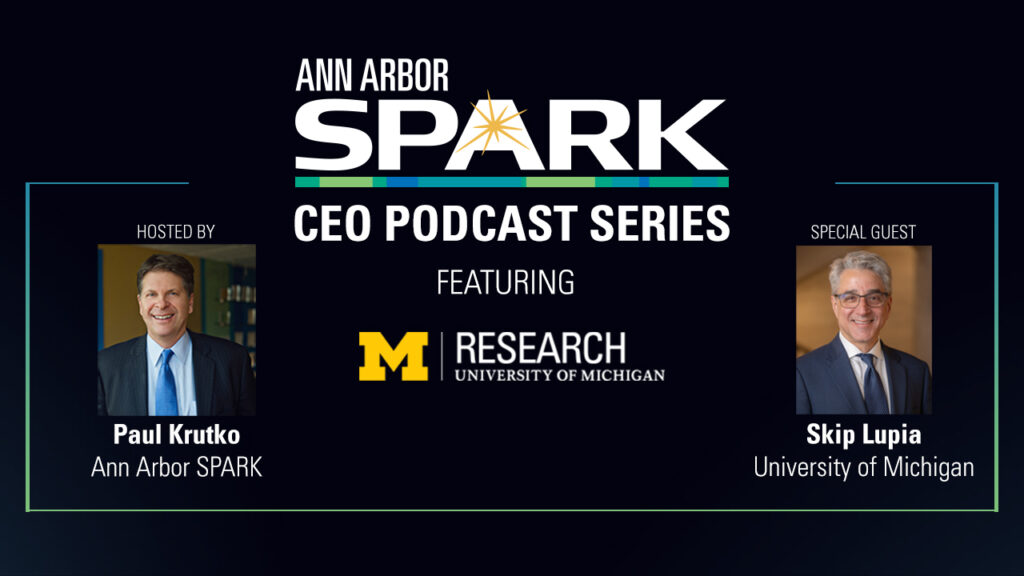
U-M Vice President for Research and Innovation Dr. “Skip” Lupia joins Paul Krutko to talk about what makes Michigan’s research engine so powerful: massive scale, top-tier talent, and the ability to rapidly form expert teams that tackle big challenges. He highlights U-M’s deep industry partnerships, national leadership in open science, and a new high-performance computing collaboration with Los Alamos that will accelerate discovery.
READ INTERVIEW
Paul Krutko: Welcome to Ann Arbor SPARK’s CEO Podcast…Conversations on Economic Opportunity. My name is Paul Krutko, and I’m the President and CEO of Ann Arbor SPARK.
Joining us today is Dr. Arthur “Skip” Lupia, vice president for research and innovation at the University of Michigan. In this role, he leads the Office of the Vice President for Research, supporting the university’s faculty, staff, and students as they pursue discoveries and creative work across U of M’s three campuses.
Dr. Lupia is an accomplished researcher, administrator, and educator whose federal service spans two U.S. presidential administrations. He previously served as assistant director at the National Science Foundation, where he worked to strengthen the public value of research nationwide, and he co-chaired the government-wide Subcommittee on Open Science for the White House Office of Science and Technology Policy.
At the U of M, Skip has held distinguished faculty roles, including the Gerald R. Ford Distinguished University Professorship. He leads Bold Challenges, a cross-campus initiative tackling issues such as equity, health, infrastructure, and sustainability. He’s also received the President’s Award for Public Impact and serves on several National Academies advisory councils focused on research excellence and integrity.
Skip, welcome to the podcast.
Skip Lupia: Oh, thanks for having me.
Paul: Yeah. So to start with, could you tell our listeners a bit more about your role at the University of Michigan, what that looks like day to day, and how your office supports such a large and diverse research community?
Skip: Yeah, thank you for asking that question. So we have this amazing university. It brings together subject matter experts from all over the world and the experts challenge each other and inspire each other and just create all kinds of innovation. And some of that turns into products, and some of it turns into great students, but that’s what I get to oversee. I work with people around the university, both on how we can do this more effectively, how we can relate with partners more effectively, and how we can do it ethically.
We do all kinds of research from stuff in the arts to stuff in medicine to all kinds of stuff in transportation.
We live in a lot of different regulatory environments, and so my office’s job is to make that all works together, make sure that we’re totally compliant with regulations so that we can innovate like no other place in the country.
So it’s a job that I’m honored to have because the public mission of this place is vital, and our job is to execute it as effectively as we can.
Paul: And it’s also probably very important, looking for all kinds of opportunities to make that happen as well. So the scale of the research enterprise is extraordinary. I mean, it spans those three campuses, as I said, thousands of faculty, students, and staff. How would you describe the scope of that work and what makes U of M’S approach to research distinct?
Skip: Yeah, well, for those who are still on Twitter or X or whatever it’s called this week, one way to describe it is the University of Michigan is the largest comprehensive public research university in the country. You can look at it by how much we spend, by what we’re involved in, by the number of people we employ. And so that’s an incredible thing, not just because of the size, but because of what I refer to as the combinatorics. When you’re that big and you’re really good in a lot of areas — I think we have over a hundred graduate programs in the top 10 nationally — when you do that, you have this agility that is problems come at you, the world changes, and you can bring together expert teams, you can draw from all these expert pools and you can put together dynamic teams in a way that almost no one else in the country can.
And so that’s really the heart of our research enterprise, and what makes it distinct is our ability to pull that type of thing together.
I mean, the private sector is great, but if you’re in a company and you have a certain time horizon, there are certain types of people you can bring together. We have a different time horizon. Universities last for thousands of years, and so we can take certain types of risks and bring certain groups of people together, it’s just really hard for anybody else to do that, allows us to seed ideas, encounter risky ideas in ways that I think compliment what a lot of businesses do. And in fact are almost like a proving ground for ideas that can then benefit society in a lot of different ways. But it is extraordinary. We get people from all over the world, and just on a daily basis, it’s incredible to behold.
Paul: Well, it sounds like you have fun doing it, too. So a lot of conversation about what happens in creative situations these days is that connecting what may be two disparate kinds of expertises and they come up with something completely new and incredibly different. So yeah, it makes a lot of sense. So part of what makes the ecosystem dynamic is how it connects with the private sector.
Can you share a few examples of how U of M partners with industry, and whether that’s through applied research technology transfer, or startup formation?
Skip: Yeah, we do this in a couple of different ways. I would say our strength lies in how seamlessly we can connect world-class research in a whole bunch of areas with real-world impact by collaborating with folks in the private sector.
So we do this in a couple of ways. One is through applied research partnerships. So in those cases, our researchers work collaboratively with industry leaders in sectors like mobility or advanced manufacturing or clean energy. And these collaborations allow companies to tap right into U of M to get access to the expertise while giving faculty and students opportunities to test ideas at scale.
Another way we do this, and I’ll bet a bunch of your listeners are already familiar with this, is through our innovation partnerships team led by Kelly Sexton, which I know the SPARK folks know she’s your board chair, and that’s the university’s destination for corporate partners who are seeking research collaborations with the amazing faculty here where the emphasis is on translating novel ideas to commercial applications.
We have a lot of new ideas coming from there, and that complements a portfolio of relationships we’ve had for a long time. We have relationships with Michigan giants like Ford and Dow, and so we’re doing that stuff along the same time. We’re taking the next generation of entrepreneurs and helping them along.
I guess another thing we do, and we love what SPARK is doing here, is trying to support the idea of bringing corporate partners to have a physical presence here. And so we work so much with you and all of your partners, and we can talk through a number of the examples, but we love doing that. And again, the university is great, Ann Arbor is amazing, and when you put those two things together, the value proposition is really just more and more apparent to a lot of companies. So we love being part of that and we love doing it with you guys.
Paul: And what’s been a real sweet spot for us in the recent past is across a number of verticals, companies that say they want to their physically bring their research enterprise to Ann Arbor so that they can even have a closer proximity. And that’s really significant in terms of, that’s in a basic way for economic development, that’s capital investment, increased property taxes, and all kinds of jobs that are created for the talented workforce here. So yeah, the partnership has been very significant, and we’ve talked about on the podcast a number of times, some of those examples. Well, let’s shift a little bit.
You co-chaired the subcommittee on open science at the White House Office of Science and Technology policy, helping increase public access to federally funded research. How do you see open science and data sharing influencing the future of discovery?
Skip: Yeah, it’s really vital. I mean, in a way, it’s the seed corn of so much of what we do. And so universities do a lot of what you might call basic research, exploring questions that if you get a certain answer, you can apply it in all kinds of different ways and take risks. And we can work on 5, 10, 20-year timelines on questions where, again, the private sector is great, but sometimes it’s hard to make that type of financial commitment. Universities can do it. And so I have worked to really make open science more valuable to the nation.
So one of the things I had to do in the White House, and if you’re a nerd, you’ll appreciate this, I worked for about a year with about 30 federal agencies on harmonizing metadata standards. And if you’re a nerd, you’re like, I totally get that. And if you’re not, like, what is that? And so basically, if one agency has a whole database that you could use to inform a whole bunch of new activities, the chance that another agency has the same organization of their database is like zero. Every agency is doing their whole thing. So we worked for over a year to have 30 federal agencies agree to metadata standards, which is really the information underlying a data set so that your data can basically talk to my data, or at least you can merge them in interesting ways. So we got that done is a lot of negotiation. It’s almost like people speaking 30 different languages and trying to decide what language you’re going to have the meetings in. But we did that and thank God we did because this happened before the pandemic and then when the pandemic happened, the agencies really needed to share data and instead of arguing over how we were going to do that, we already had a common language and that made it much easier to do.
But the same dynamic, I think if businesses want to use the amazing federal data resources to inform what they’re doing, having common underlying standards just makes it easier because open science is one thing, but if you can’t read the data, it doesn’t count for me. So that’s a lot the work I did there.
Paul: Well, that’s tremendous. I mean, it is interesting because what happened, I think in the adoption of software and data and computing over the last decades, each agency or a company said, I need to have a data set of my own. So they would go procure that because there wasn’t the overarching system at the beginning, it creates this kind of friction that you work to overcome. So that’s fabulous.
Skip: Can I say one more thing about this? That listeners know when people think about federal agencies in Washington, you might think that everything is partisan. And when it comes to the value of most of this data, all the work I did was bipartisan. So you mentioned I actually worked under the Trump administration and the Biden administration, and when there was a change, the mission and work of my part didn’t change a lot. We really needed, both for government and the private sector, this data to be as valuable as possible. So if you’re looking for nonpartisanship in Washington, you can find it around data standards.
Paul: That’s true. Then it becomes when you get the data, how do you use the data? But that’s a different, a totally different, totally different committee. So yeah, just a couple more and then we’ll let you go. We know how busy you are.
As we look ahead to 21st-century infrastructure, why is computing capacity become such a critical focus for U of M’s research, and how does the new partnership with Los Alamos advance that work and advance computing and data intensive search? I think a lot of people think, well, this is a data center, but I know that it’s not what it really is intended to be. It’s intended to advance the research mission. Explain that in a little more detail.
Skip: I’ll give you an example. So for the past a hundred years or 200 years, science has worked in the following way: you run an experiment in your lab, and then you take a couple of weeks to write it u,p and then you publish it somewhere, and then a couple of weeks or months or years later, I read it and it influences me and my group. And so we run an experiment, and a couple months later we publish it and a couple months later you read it. And so science advances and advances really slowly. Now imagine an environment where when you’re planning an experiment, you have not only instant access to every experiment that was run there, but you can put in a couple attributes of what you’re thinking and it’ll show you what type of experiment you could run that would allow you to learn as much as possible.
And the second you ran that experiment and put it into a database, everybody else working on this could see it too. So the speed at which you can change scientific progress is unbelievable. Moreover, a lot of what AI does, it’s not just speed, it’s how you organize memory, how you organize facts and make them available for future inference. So again, right now in science, everybody works really hard, but I don’t know what most people in my field know right now, AI really changes what we might be able to know.
And so that’s the reason that computation matters in terms of Los Alamos. Los Alamos is a federal lab, and again, I know there’s some controversy, but it’s important to know that Los Alamos is part of the Department of Energy and not the Department of Defense. So Los Alamo’s portfolio includes lots of things with energy and there are some things that are in nuclear deterrence, which is really important for the country.
But everything else that has to do with energy in terms of propulsion and how we think about conservation and using energy efficiently, it’s all within the remit. And so they study all of those things because part of their mission. And we at the university study some of those things and way more, we study law and business and ethics and things of that nature. So when you put the two of us together, they have deep knowledge of a couple areas that are like, oh, those are interesting cases. And we have broad knowledge of a lot of areas where they’re like, we could understand more about sustainability if we work with you guys. So now that’s the reason for the Los Alamos Michigan partnership. And it’s been going on for decades. We’re their largest academic partner already. But now, when you add computation to the mix, we have this capacity to do later.
I was talking before, we can see each other experiments, we can look at data that’s been collected by other people instead of waiting years or months to try and figure out what it might mean for us, we can figure it out in days or minutes and we can do things that advance the mission of the university and the mission of the agency faster. So it’s a very exciting partnership. We’re thrilled to work with Los Alamos on this. We have a joint effort with them. It is fully joint. It’s working on topics that we’ve been working on at the university for decades and things that they’re interested in. So it’s really great.
Paul: And I guess in a layman’s perspective, it’s an advanced tool to allow scientific research to advance quicker, faster, and better in a real way. So we’re going to close out. Last question.
When you look at the future of research and innovation both here in Ann Arbor and nationally, what gives you the most optimism about where we’re headed?
Skip: What gives me optimism is people. I’ve worked in a lot of different places. When you work at a public university and you go into a meeting and you’re trying to talk about what to do next or how to approach a problem, everybody understands that we are here to serve the public. That is job one. And that both centers you at key moments, focuses you when things get complicated. And I actually think it gives a lot of range to take certain types of risks. Now we’re thinking, if we want to serve people as well as we can, can we think about new ways of working together? Can we reinvent ourselves to do that? And that’s really exciting. And people who come to universities or people who, in all the businesses we work with, I mean, we get to work with folks who are re-envisioning the future.
And again, if you’re coming to a public university, you’re often thinking about how do I save lives more effectively than I did yesterday? How do I sort of spur economic growth in a way that we didn’t do before? How do I empower community? How do I improve quality of life? Those are the central organizing principles of this university. And when we have those conversations or when we work with partners, you see the best of this country. You see the best of what people can be. We’re so blessed in a way to be in Ann Arbor, Michigan at this period in history or in this region, this period in history. We’ve got so many people who have come here to ask those questions, to make those advances. So I wake up every day optimistic because I know about all the things that are possible here. And to your first question, what’s my job? My job is to make those conversations as effective as possible, to make them as numerous as possible, and to make them as meaningful as possible. And I’m grateful for that opportunity and for what you and other people in the area do to support that same cause.
Paul: Well, thank you. We feel blessed as an economic development organization to have such a strong partnership with the University. And some have heard this other times when they’ve listened in, but SPARK wouldn’t have started or existed without the University’s leadership. And it was, we want the university. It is plain off what you just said, the president at the time, Mary Sue Colman looked around and said, we need to have more of an impact locally. The university has great impact globally on things that it does, the products and things that the services and things that have been commercialized that save lives and do all kinds of great things. But the university looked around and said, we want to make the place where we’re at. We want to have an impact there. And the 21 years that we’ve been working together with the university, we have gotten to a place where we’ve really built a very significant ecosystem that is achieving that. So I always reference back to that origin story because that’s a demonstration that many other places in the country haven’t had that opportunity to have such leadership from the university. So on behalf of the community, that’s my role. We thank the university for that partnership over the years.
Skip: Yeah, I’ll throw that back at you because I feel like what Ann Arbor SPARK does in so many ways is take what people want a university to do and make it actually make that actually happen. So we can generate ideas, but it’s really hard to scale it and sort of turn it into something that is a tactile experience for people that changes their life. You guys just assemble people, bring together resources, facilitate ideas, provide the support that take the dreams that start here and turn them to realities in the world. So it’s a great partnership.
Paul: Well, as we end this sort of love fest on our conversation here, I just want to thank you, Skip, for spending some time with me today and looking forward to what we’re going to be able all to do together in the next few years.
Skip: Absolutely. Thanks for having me. Go blue!
Paul: And I want to thank our audience for listening and learning more about those leaders and organizations working hard to create the Ann Arbor Region’s economic future. These conversations are brought to you by Ann Arbor SPARK. For more information about Ann Arbor SPARK, you can find us on the web at annarborusa.org. We’re also on Facebook, Instagram, and LinkedIn.
Dr. Arthur Lupia’s Bio
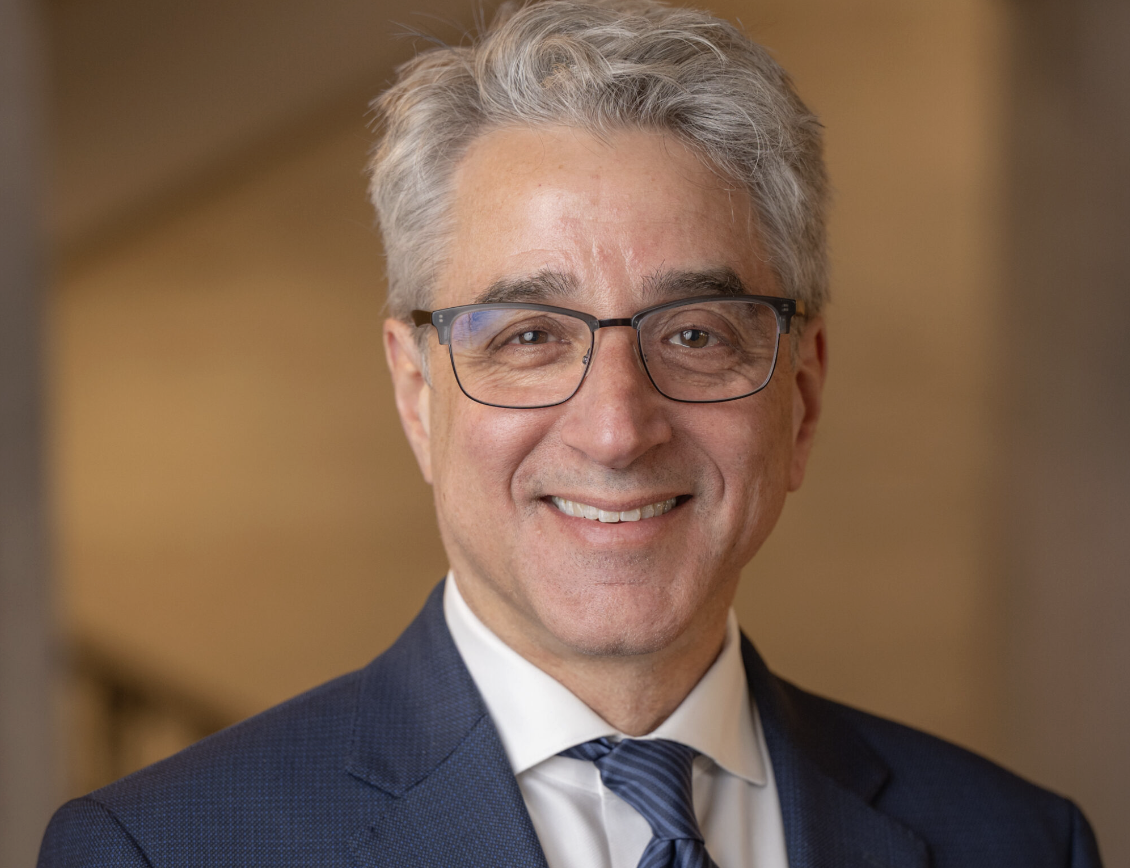
Dr. Arthur (Skip) Lupia is vice president for research and innovation at the University of Michigan, where he is responsible for fostering the excellence and integrity of research across all three campuses. As vice president, Lupia leads the Office of the Vice President for Research, whose mission is to catalyze, support and safeguard U-M research and scholarship activity.
Lupia has vast experience as a researcher, administrator and educator, whose federal service spans two U.S. presidential administrations.
Lupia joined U-M in 2001 as a professor of political science and a research professor at the Institute for Social Research. He was appointed the Hal R. Varian Collegiate Professor from 2006-20, and the Gerald R. Ford Distinguished University Professor in 2020.
Lupia served from 2018-22 as an assistant director of the National Science Foundation, where he developed strategies to increase the public value of research across NSF’s entire portfolio.
He also co-chaired the government wide Subcommittee on Open Science for the White House’s Office of Science and Technology Policy between 2019-22, convening leaders from more than 30 federal agencies to increase access to, and the public value of, federally funded research.
In 2022, he became executive director of Bold Challenges, where he leads collaborations with research centers and institutes across all three U-M campuses to address societal challenges that intersect with equity, health, infrastructure and sustainability. He was named an associate vice president for research in 2023.
Lupia is a recipient of U-M’s President’s Award for Public Impact. He is a member of the National Academies of Science, Engineering, and Medicine’s Strategic Council for Research Excellence, Integrity, and Trust, and serves on the National Academies’ Advisory Board for Engineering and the Physical Sciences
He received a bachelor’s degree in economics from the University of Rochester, and Master of Science and Ph.D. degrees from the California Institute of Technology.
