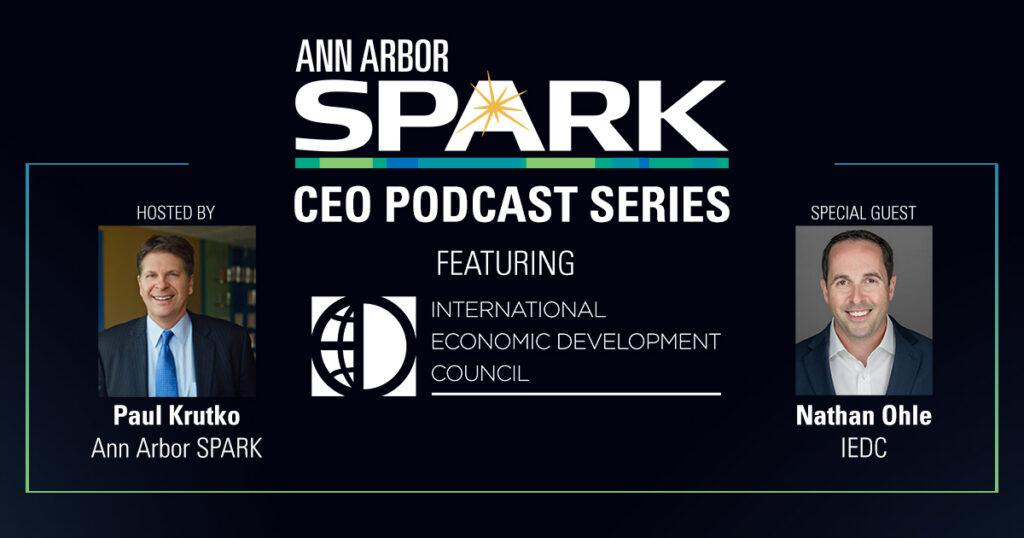
In this episode, Paul Krutko chats with Nathan Ohle, President and CEO of the International Economic Development Council (IEDC). They discuss IEDC’s mission to drive global economic prosperity, its role in disaster recovery and community resilience, and the upcoming IEDC Annual Conference in Detroit (Sept. 14–17). This global gathering of 1,700 leaders will showcase Michigan’s innovation, highlight opportunities for communities, and connect professionals shaping the future of economic growth.
READ INTERVIEW
Paul Krutko: Welcome to Ann Arbor SPARK’s CEO Podcast…Conversations on Economic Opportunity. My name is Paul Krutko, and I’m the President and CEO of Ann Arbor SPARK.
Today, we’re talking with someone who is helping shape the future of economic development not just here in Michigan, but across the globe — Nathan Ohle. Nathan is the President and CEO of the International Economic Development Council, the largest membership organization for economic developers worldwide, representing more than 5,000 members. His career spans decades of leadership at the local, state, and federal levels, including serving as Senior Advisor at the U.S. Economic Development Administration.
Nathan is here to talk about IEDC’s Annual Conference, happening in Detroit September 14–17. We think it’s a tremendous opportunity for our listeners to find out about it and if their schedules allow, to try to take part in the conference. And we’re really excited that the conference is coming to Detroit because we think the region is really showing its resilience and its transformation. And for us in Ann Arbor, it’s a chance for us to showcase what we just recently found out — that we’re the fifth leading innovation center in the Midwest, only behind Chicago, Indianapolis, Pittsburgh, and Minneapolis. So we’re kind of proud about that, but anyway, how are you doing, Nathan?
Nathan Ohle: I’m doing great, Paul. It’s great to be with you. Thanks for the opportunity.
Paul: Yeah. So just for the listeners to know, I am a shameless shill for the IEDC. I’ve been involved in the organization as a professional since 1995 and did have the honor of at one point being the chair of the board of the organization. But for listeners that don’t know anything about IEDC, Nathan, take a moment and talk about what the mission is, why it’s important, what the organization brings to the table, not only for members, but how you represent the profession in Washington and elsewhere.
Nathan: Yeah, the International Economic Development Council, IEDC, as Paul said, is the world’s largest association for economic developers, and that means anyone doing economic development from a university to a nonprofit to a public sector employee, public-private partnerships, chambers, you name it. If you’re doing economic development, you engage with us in some way, shape, or form. As a membership association, all of our work is centered on our members and the communities they collectively serve. How do we drive economic prosperity and quality of life in places of all sizes across every region across the world? For us, it is about engaging those practitioners, those folks on the ground, learning from them and helping them to learn from one another, building connections between and among not only those practitioners but the communities they serve, and obviously trying to raise the profile of economic development, the work itself and the profession, but also helping to lead it into the future.
We know that there’s a pretty dynamic environment on the ground right now for economic developers, and so we’re trying to stay on the front edge of providing tools and resources for those practitioners to do really good work to bring them together to make sure we celebrate the profession, and then also to help them in their own professional careers. So we have a lot of professional development offerings, both courses and two different certifications that people can go through. We also accredit economic development organizations, and then we also do a lot of research policy and advocacy mostly on the policy and advocacy side here in DC at the federal level. We also engage with all the state associations, including MEDA and many others for the state level legislation that they’re working on, and certainly internationally with our international counterparts on a whole host of opportunities. And then we build partnerships, trying to help drive economic prosperity once again in communities, but also bring the field together, help them understand where they can lean in more deeply at the local or regional level and ensure that we are lifting up the profession itself and moving the field forward.
Paul: Take a moment, too, and just talk about some of the initiatives where communities have faced traumatic events and how IEDC has responded because many times it’s, first we all talk about first responders, the EMT, the utilities, but then in the aftermath, businesses have been destroyed, facilities, and the IEDC has taken a leadership [role] with the federal government and responding to that. Take a moment to talk about that.
Nathan: Yeah, we’ve got a couple decades worth of history really tracking back to Hurricane Katrina in what we call disaster recovery, economic development work around disaster recovery. So essentially after those, the initial lifesaving efforts come in, which obviously are critical to any region, any community, helping the community think about, okay, what is the future for themselves from an economic development perspective, what should they be thinking about in a planning and implementation side? And how do they access resources, both from the federal resources that might be available through disaster supplemental funds, for example, but also how do they build in those connections regionally, locally, statewide, to make sure that they have both a plan in place and can implement and have the resources and capacity to do those things.
So it started with Hurricane Katrina, but we’ve dealt with hundreds of disasters across the United States and even in some cases abroad, to really help those communities think about that long-term planning piece as they start to get into the recovery mode after disasters.
We’ve also helped in economic disasters where a company or an industry leaves a community and it leaves a gaping hole for those communities, helping them to really think about the diversification efforts, the opportunities to build from within and grow from within. And then also we do a host of other technical assistance projects based on needs of communities. In some cases, we’ve got a new program called the Economic Recovery Corps, which is focused on long-term capacity building in communities of all sizes across the United States, but we also do very specific projects where a community has a need where we can draw from the expertise we have across our membership and add value to what they’re trying to do.
Paul: So before talking specifically about the upcoming conference, I did want to touch on one more point, which is IEDC is an apolitical organization, and one of the things that you do for the membership that is difficult for us sometimes is help us understand sort of policy changes and programmatic changes at the federal level. And so I think it’s an important thing that you do, and I know we all have an opportunity where at the beginning of the year where we have a chance to come to Washington and learn more about that, but I think that’s something I wanted to point out to everyone, that this is a organization that it’s about uplifting all communities regardless of what their particular political persuasion might be.
Nathan: That’s exactly right. We’re bipartisan. Economic development itself is a bipartisan issue, right? Both Republicans and Democrats all the way across the spectrum care about creating jobs, driving economic prosperity, and quality of life in their communities. And so for us, we represent the full field people from every community, every walk of life with all very different priorities in the way that they’re trying to move forward their economic development efforts. So we are the voice for economic developers, especially here in Washington D.C. Obviously, a lot of economic developers are in close contact with their members of Congress all the way through the year. So we do have those opportunities when they come to D.C. to try and pair those opportunities, to continue those connections. But it’s also about helping our members understand the value and importance of building those relationships and having a voice in those conversations, not just when you come to D.C., but probably most importantly when you’re at home, when you’ve got a congressional member who might be coming through your district or you’ve got a specific issue that your community needs to attack or address in some way, shape or form, and policy can be an incredible lever. It can also be a very difficult lever to pull. And so building those relationships all the way through the years is really critical.
Paul: Well, interesting. When I was in just a little story for the listeners, when I was in Washington at the meeting in February, I got the chance to meet with new staff members working for Senator Slotkin, and that turned into yesterday’s Senator Slotkin meeting with us here in Ann Arbor. So it goes to what you’re speaking. So tell us about if somebody’s thinking, Hey, you’re having this conference in Detroit and it’s close to me, what can they expect if they sign up for this conference? What kind of program is it?
Nathan: Well, first of all, I just want to say how excited I am to be coming to Detroit. Paul knows I’m a Michigander. I’ve been in the D.C. for about 10 years, but grew up in Michigan, went to school at Michigan State, so being able to bring the conference back to Michigan is a really proud moment for me. And Paul has played a really integral role in bringing the conference to Detroit. We always have what we call a host committee, local partners, regional partners in that area that really help to spur the conversation around why it would be important to be in that place, but also help us to really get ingrained into the community, into the region and the things that we’re doing.
These conferences are always an opportunity to highlight not just the region, but the state that we’re in, and obviously Michigan has a great story to tell in the work that’s happening all the way across the state from Ann Arbor all the way up to the Upper Peninsula.
For us, this is our largest conference of the year, about 1700 folks that come from across the globe to participate in this. There are seven different tracks of content, so breakout sessions focused on different topics, entrepreneurship, workforce development, all those kinds of things. Obviously, we have those big plenary sessions where everyone is together to talk about important topics, but then we also do tours throughout the conference so we can get people out into the community to see the projects, to see the development that’s happening. One of those tours will be coming directly to Ann Arbor. We’ve got a number of ’em in downtown Detroit, one that’s going to Dearborn. So we try and get across the region so folks can get out of the conference itself and see what’s literally happening on the ground in the community.
And then we also do a number of events at night, networking opportunities for people to connect with one another. Whether you are coming from an international community, there’s a dinner that we host for folks that are both coming from international places, but also those that work internationally. We do a number of different receptions. We do some fun ones right on site, and then we do some out across the community, again, to make sure that people get into the community and see it. So it’s an opportunity for anyone to come and learn to connect with other people, not just in Michigan, but across the globe, across the country, and really to take away things that they’re going to learn, particularly through those breakout sessions where they can apply it to their community.
It’s one of the most important parts to me is where people can recognize where they had struggles or where there was difficulty or maybe even a failure of a project that helps someone else not have to go through that same failure or to learn from what really worked well in their community or in their region that then can be applied back in your community. It’s a great opportunity to learn, to connect with folks, and obviously also to celebrate economic development as a field and profession.
Paul: Yeah. One of the things that I would share with the audience is that we’re excited about it being here because oftentimes local officials, people involved in economic development, don’t have the budgets to travel to the conference. And so one of the things at SPARK we’re taking advantage of, we’re going to have 14 staff members attend and give them free rein to go learn about ideas from all over the country. And I’m looking forward to a week after sitting down with that team and saying, Hey, what session did you go to? What did you learn about?
We’re excited about showcasing Ann Arbor for those folks that want to come from around the country to learn about what we’re doing.
But I just want to share one story that really speaks to the power of the conference. We were in Denver last year, and I got to learn about the SizeUp data tool, and we then reached out and we now have implemented that program, and we are offering it for free to small businesses all over Ann Arbor and Washtenaw County with great pickup, and small businesses finding it a great tool for them to learn about where can I expand? What are my peers doing? It was just regret. But without having gone to the conference, and this is the point I’m making to anybody who might be thinking, why should I go, is I wouldn’t have had that opportunity to see that on the agenda.
So as we close out, where can people go? I’ll let you tell ’em the web address, and then when we post this, we’ll put it up again, but where can they go?
Nathan: Great. Our website is ww.iedc.org. We’ve got a great website out that shows the whole program, so you can see the speakers and the plenary sessions. You can see the topics of the breakout sessions, you can see the tracks of content there, as well as any of the opportunities in the evening, any of the receptions, any of the ways to network. So iedc.org, and then just link straight to the conference. It’s right on the homepage and easy to find, and it’s a great opportunity for you not only to get connected with other folks across Michigan, but across the country, across the globe, take a lot from it. And what I tell everyone is, you’re going to get out what you put into these things. And so if you’re planning to come, if you’re thinking about coming, even if you can only make it for a day, there’s value for you to find there, whether that’s around the connections with people, the learnings from the breakout sessions and topics, we encourage you to come engage with us and most importantly, give us feedback afterwards. What else can we do to continue to make this as valuable as possible?
Paul: Well, that’s excellent. And just reiterate, the dates we have are September 14th through the 17th. That’s the Sunday through a Wednesday. The conference has two full days on Monday and Tuesday and half a day on Wednesday, just so everybody knows that. And the location’s the Huntington place, so those of you who might be coming from somewhere in southeast Michigan or elsewhere in Michigan, it was Cobo Hall, it’s called Huntington Place now, has plenty of parking and lots of things to do in Detroit as well. So the host committee is also excited about the fact that we’re going to have this many people. One of the things that you always think about stuff like this, Nathan, when you have it, it’s an economic development opportunity for your community, 1700 people here and learning about. And what we’re also excited about just to close out, is there has been a renaissance and the community has really uplifted itself through a lot of different ways, philanthropic, the corporate community. I mean, there’s an opportunity for those who haven’t seen Michigan Central to see that, but it also helps us change a narrative that may have been out there nationally about what Detroit is. And so it’s a really exciting opportunity, and that’s why we pursued it, and to let people know, the board gets to decide where they go. I mean, we had to make a pitch. We had to ask for the business, as we say in economic development, so we’re excited about it. So Nathan, thanks a lot for taking a couple of minutes and sharing with us what’s coming up.
Nathan: Absolutely. Thanks for the opportunity, Paul. And most importantly, thanks for your continued commitment, not just IEDC, but hosting this conference in Detroit. As you mentioned, we make choices on these things based on good stories to tell in Detroit. Certainly, Detroit and the region have a great story to tell.
Paul: Thank you, Nathan.
And I want to thank our audience for listening and learning more about SPARK’s business development activities and how they impact the Ann Arbor region’s economic future.
For more information about Ann Arbor SPARK, you can find us on the web at annarborusa.org, and also on Facebook, Instagram, and LinkedIn. And if you’d like to attend the IEDC conference, please visit detroit.iedconline.org to register.
Take care, Nathan. See you soon.
Nathan: Thanks so much.
Nathan Ohle’s Bio
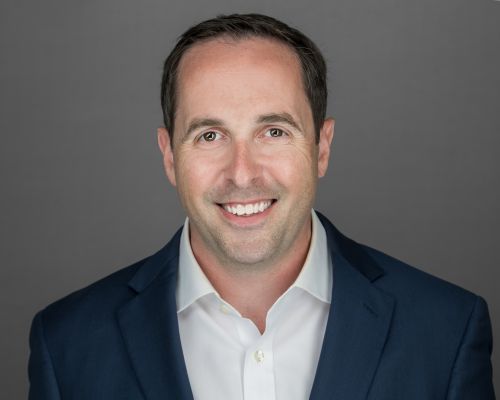
Nathan Ohle is an internationally recognized expert in economic development and a leader of public, private and nonprofit organizations. He currently serves as the President & CEO of the International Economic Development Council (IEDC), a non-profit, non-partisan membership organization serving economic developers, with more than 5,000 members globally. In 2017, he was selected as one of 40 Under 40 Rising Stars in economic development internationally.
Nathan’s economic development experience and leadership span decades at the local, state, and federal levels. He served as the Senior Advisor at the U.S. Economic Development Administration (EDA), overseeing policy and external affairs. He also was the lead for the U.S. Department of Commerce on the White House Rural Council and the Administration-wide Community Solutions team, leading initiatives across the Department of Commerce, as well as serving as the Deputy Director of the Detroit Federal Working group. He developed new partnerships for EDA and created the first-ever Office of Philanthropic Engagement at the Commerce Department, helping align the interests of the philanthropic sector with the federal government.
Before joining IEDC, Nathan was the Chief Executive Officer of the Rural Community Assistance Partnership (RCAP), a national network of non-profit partners working to build capacity in rural and tribal communities across the country. Under his tenure, RCAP’s budget and team almost tripled, expanding work in economic development, access to safe drinking water and sanitary wastewater, and disaster recovery for rural and tribal communities across the country. He led RCAP’s operations and strategic planning, serving more than 3.4 million rural and tribal residents in 2020.
Before moving to Washington, DC, Nathan served in the non-profit sector and as the Board Relations Liaison for the Michigan Economic Development Corporation. He holds two degrees from Michigan State University.
Nathan has served on several non-profit boards and is an active volunteer in the community. He resides in Falls Church, Virginia, with his wife and two children.
